
Why Your Spine Lies: The Hidden Truth About Proprioception
Most people think they know where their body is in space. The truth? Your proprioceptive map is a hallucination your brain constantly updates. Breathing reveals the glitches in your internal GPS.

Searching for what was always there
Close your eyes. Tell me where your left shoulder blade is right now.
Not where you think it should be. Not where anatomy textbooks say it lives. Where do you feel it?
If you hesitated—if there was even a flicker of uncertainty—you’ve just discovered something most people spend their entire lives ignoring: your body is lying to you.
The Map Is Not the Territory (And Your Map Is Outdated)
Here’s the truth that neuroscience has known for decades but nobody bothered to tell you: the “felt sense” of your body—that internal knowing of where your limbs are, how you’re positioned in space—isn’t a direct transmission from your muscles and joints. It’s a predictive model. 1
Your brain doesn’t passively receive signals from your body and display them like a dashboard. Instead, it actively constructs a representation—a best guess—of where you are based on past experience, habit, and computational efficiency. 2
Think of it like this: your brain is running outdated software. The map it’s using to navigate your body was optimized for a past version of you—one who didn’t spend 8 hours a day hunched over a keyboard, 3 one who hadn’t braced against that breakup, that layoff, that decade of holding your breath through every difficult conversation.

When the internal map doesn't match reality
The map is a hallucination. And for most of us, it’s years out of date.
The Glitch: How Stress Carved Blank Spots Into Your Body
Your body doesn’t develop “blind spots” because of nerve damage. It develops them because your brain, in its ruthless pursuit of efficiency, has learned to ignore you.
This is the part that feels almost cruel when you first understand it: the numbness isn’t a lack of signal. It’s your brain actively tuning you out. 4
Here’s the mechanism: When you experience chronic stress—whether it’s a trauma that never fully resolved or just the slow accumulation of years sitting still—your musculoskeletal system freezes into rigid patterns. Your shoulders lock. Your jaw clenches. Your psoas grips like a fist that never opens. 5
At first, your brain registers this. Shoulder tense. Shoulder tense. Shoulder tense. But here’s where it gets insidious: these signals become predictable. And your brain, operating on a principle called sensory attenuation, has a rule: predictable signals are uninformative signals. 6
So it does what any efficient system would do: it stops listening.
The chronic tension in your shoulder keeps screaming, but your brain has turned down the volume to zero. You can’t feel it anymore. Not because the nerves are broken, but because your brain has decided that signal isn’t worth processing. 7
This is the “glitch.” This is the blank spot. This is why, when someone asks you to feel your left shoulder blade, there’s… nothing.

The body holds what the mind has learned to ignore
What Chronic Stress Really Costs You
Let me be blunt about what this costs.
This isn’t about “poor posture” or needing a better desk chair. This is about walking through your life in a body you can’t fully feel, making decisions with data you don’t have access to.
You know that feeling when you’re “stressed” but you can’t quite name what’s wrong? That vague sense of being “off” that you’ve learned to push through? That’s not a personality flaw. That’s not you being “in your head.” That’s a broken sensor array. 8
Research shows that poor interoceptive accuracy—your ability to sense your internal state—is directly linked to:
- Anxiety and depression 9 10
- Chronic pain that won’t resolve 7
- Difficulty identifying your own emotions (a condition called alexithymia) 11
- Burnout that creeps up on you because you can’t read the early warning signs 12
- That profound sense of disconnection and depersonalization 8

The price of years spent pushing through
Here’s the part that cut through me when I first understood it: you’re not disconnected because you’re broken. You’re disconnected because your brain is doing exactly what it evolved to do—ignore chronic, unchanging signals to conserve resources.
Your body has been screaming the same distress signal for so long that your brain reclassified it as background noise.
The Counter-Intuitive Truth: You Can’t Fix What You Can’t Feel
Every modality of body-centered healing—from Feldenkrais to Rolfing to Somatic Experiencing—orbits around the same brutal, beautiful truth: You cannot change what you cannot feel. 13 14
Moshé Feldenkrais, the physicist-turned-somatic pioneer, called it the “self-image”—that brain map that determines how you move, act, and experience yourself. 15 He discovered that awareness itself, not force, is what updates the map. The smallest, slowest movements—the ones you can barely detect—are the ones that defeat your brain’s sensory attenuation. 13
Ida Rolf, the biochemist who founded Structural Integration, understood the feedback loop from the other direction: chronic holding patterns don’t just live in your brain—they physically reshape your fascia, the connective tissue web that gives your body its structure. 16 She called this “personal history made flesh.” 17
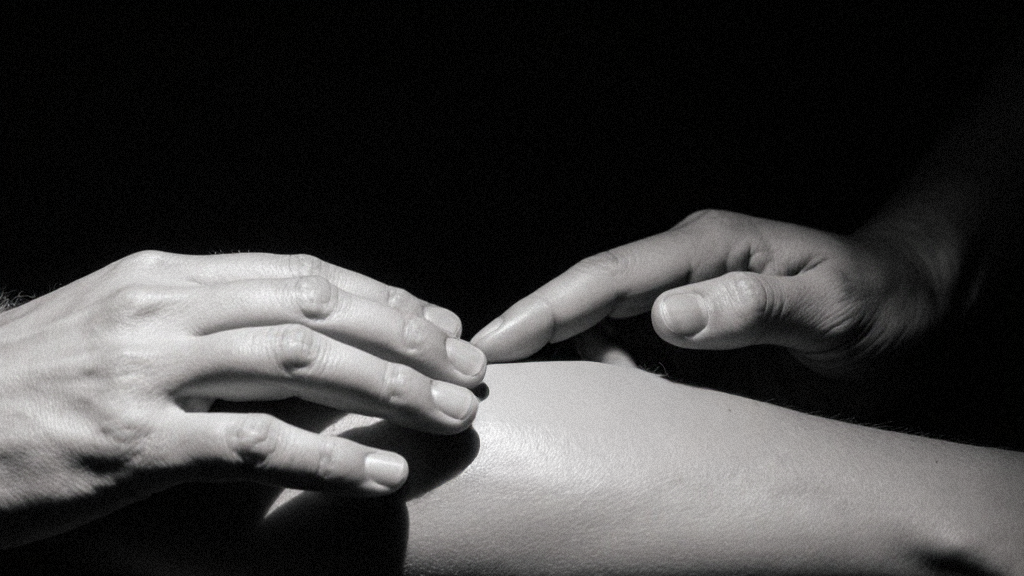
Awareness precedes all transformation
Here’s the vicious cycle:
- Your distorted mental map creates chronic muscular holding
- Chronic holding reshapes your fascia into rigid patterns
- Rigid fascia sends distorted signals back to your brain
- Your brain uses these distorted signals to confirm its original distorted map 17
Software corrupts hardware. Hardware reinforces corrupted software.
This is why pushing through doesn’t work. Why “just relax” is useless advice. Why all the foam rolling and stretching in the world won’t fix the root cause.
The map has to update. And the map can only update when you generate new, unpredictable data it cannot ignore.
The Bridge: Why Your Breath Is the System Interrupt
Here’s where it gets unexpectedly hopeful.
There’s one system in your body that is both fully automatic and fully voluntary. One system where you can consciously override your brainstem’s default programming and send a novel, high-priority signal through the entire predictive network. 18 19
Your breath.
When you’re asleep, breathing is controlled by ancient brainstem structures—offline, automatic, metabolic. 18 But the moment you consciously direct your breath, you activate an entirely different neural network: a frontotemporal-insular circuit that lights up your anterior cingulate cortex (your brain’s conflict monitor) and your insula (the critical interoceptive hub where all your internal signals integrate). 19 20
This is the neurological architecture of a system interrupt.
When you consciously breathe into a blank spot—that numb shoulder, that disconnected low back—you’re not just “sending oxygen there.” You’re doing something far more precise: you’re creating a prediction error.
Your brain’s model says: “This area is numb. There’s nothing to feel here.”
Your conscious breath sends a real signal: “Pressure. Stretch. Movement. Sensation.”
Prediction ≠ Reality.
That mismatch—that gap between what your brain expected and what it’s actually receiving—forces the map to update. 21 You’ve just hacked your way past sensory attenuation by making the signal unpredictable again.

The voluntary made conscious
This is why conscious breathing isn’t just “relaxation.” It’s a diagnostic tool. It’s a way to find the glitches in your internal map and generate the prediction errors that recalibrate it. 19
What Recalibration Feels Like
The research uses clinical language—“interoceptive accuracy,” “vagal tone,” “autonomic regulation.” But let me translate what this actually feels like when your map starts coming back online:
You learn the difference between “braced tension” and “energized readiness.” 22
Most high-performers spend years thinking their drive requires bracing for a fight. That cortisol-fueled, sympathetic-dominant state becomes synonymous with ambition. But Polyvagal Theory makes a critical distinction: there’s a difference between mobilization-with-fear (sympathetic fight-or-flight) and mobilization-without-fear (ventral vagal engagement). 23
When your nervous system recalibrates, you discover you can be driven and safe. You can pursue goals without your body treating every deadline like a predator. This isn’t less ambition. It’s sustainable ambition. 24

The body remembers how to move freely
Your anxiety stops being a “cloud in your head” and becomes a shape you can work with.
One practitioner described it perfectly: “My anxiety isn’t just a cloud in my head anymore. I can feel its specific ‘shape’ as a held breath in my stomach.”
This is clinically accurate. Anxiety isn’t just a thought—it’s torso stiffness, disrupted breathing, chronic muscle tension in specific, patterned places. 25 26 When you can map the physical architecture of anxiety, it stops being an abstract monster you endure and becomes a sensation you can meet with a tool. 27
You develop a reliable internal “check-engine light.”
This might be the most profound shift: the restoration of interoceptive accuracy means you catch the glitches when they’re still small signals, before they cascade into chronic pain, burnout, or total system shutdown. 28
High interoceptive awareness acts as an early warning system—you feel the stress response ramping up before it takes over, giving you a window to respond rather than react. 29 For those of us who’ve spent years disconnected, this isn’t a luxury. It’s the difference between functional and broken.
The Invitation Hidden in Plain Sight
I’m not going to end this by telling you to “try some breathing exercises” or “practice mindfulness.” You’ve heard that a thousand times, and if it were that simple, you’d already be doing it.
What I will say is this: the work of recalibration isn’t about adding something new. It’s about listening to what’s been there all along, muted beneath the static of efficiency and survival.
The blank spots in your body aren’t failures. They’re your brain’s best attempt to conserve resources in a system that’s been running on emergency power for too long. The numbness was an adaptation. It kept you functional when feeling everything would have been overwhelming.
But here’s the gift hidden in the glitch: once you understand that your map is a prediction, you realize predictions can be updated.
The neuroscience is clear. The somatic traditions have known this for a century. When you send a novel, conscious signal—through breath, through tiny differentiated movements, through curious attention rather than force—you defeat sensory attenuation. You generate prediction errors. You force the outdated map to reconcile with present reality. 13 27
This is what it means to recalibrate: not fixing what’s broken, but updating what’s stuck.
The path isn’t complicated. It’s precise. It starts with listening—to the breath you’re taking right now, to the places where sensation has gone offline, to the wisdom that lives in high-resolution feeling rather than abstract thought.
Your spine has been lying to you. But not out of malice—out of mercy. It was protecting you from feeling too much, too fast, for too long.

Ready to hear the truth
The question now is: Are you ready to hear the truth?
Footnotes
Footnotes
-
Proprioception as a sensory root for body and motor awareness, Oxford Academic Brain Communications, 2025. Source ↩
-
Deciphering Proprioception: How the Brain Maps Movement, Neuroscience News, 2024. Source ↩
-
Impact Analysis of 20-Week Multimodal Progressive Functional–Proprioceptive Training among Sedentary Workers Affected by Non-Specific Low-Back Pain, PMC, 2021. Source ↩
-
Sensory Attenuation in the Auditory Modality as a Window Into Predictive Processing, Frontiers in Human Neuroscience, 2021. Source ↩
-
Postural Responses in Trauma-Experienced Individuals, MDPI Biomedicines, 2024. Source ↩
-
Perceptual sensory attenuation in chronic pain subjects and healthy controls, PMC, 2022. Source ↩ ↩2
-
Interoception: the hidden sense that shapes wellbeing, The Guardian, 2021. Source ↩ ↩2
-
Investigating the relationship between interoceptive accuracy, interoceptive awareness, and emotional susceptibility, PMC, 2015. Source ↩
-
Does Interoceptive Awareness Influence Depression Through Anxiety in Peruvian Adults? A Mediation Analysis, MDPI, 2024. Source ↩
-
Interoceptive awareness in a clinical setting: the need to bring interoceptive perspectives into clinical evaluation, Frontiers in Psychology, 2024. Source ↩
-
Autistic Burnout: What It Is, Why It Happens, and How Interoception Can Help, Kelly Mahler, 2025. Source ↩
-
Feldenkrais core principles, Allison Suran Pain Specialist, 2025. Source ↩ ↩2 ↩3
-
Somatic experiencing: using interoception and proprioception as core elements of trauma therapy, Frontiers in Psychology, 2015. Source ↩
-
Self-Image And The Modeling Process, Feldenkrais Store Blog, 2025. Source ↩
-
Learn More About Rolfing, Darrell Sanchez: Tuning Board, Rolfing®, Therapy, 2025. Source ↩
-
Studies of voluntary and involuntary control of human breathing, NeuRA, 2025. Source ↩ ↩2
-
Breathing above the brain stem: volitional control and attentional modulation in humans, PMC, 2018. Source ↩ ↩2 ↩3
-
The Emerging Science of Interoception: Sensing, Integrating, Interpreting, and Regulating Signals within the Self, PMC, 2021. Source ↩
-
Predictions, perception, and a sense of self, PMC, 2014. Source ↩
-
What is Polyvagal Theory?, Polyvagal Institute, 2025. Source ↩
-
Polyvagal Theory: Current Status, Clinical Applications, and Future Directions, PMC, 2024. Source ↩
-
The Physical Side of Anxiety, Intermountain Health, 2025. Source ↩
-
The role of torso stiffness and prediction in the biomechanics of anxiety: a narrative review, PMC, 2024. Source ↩
-
Somatic Tracking 101: Teach Your Brain “I’m Safe”, Pain Reprocessing Therapy, 2024. Source ↩ ↩2
-
Interoceptive Accuracy Is Related to Long-Term Stress via Self-Regulation, PubMed, 2019. Source ↩
-
Interoceptive Awareness Skills for Emotion Regulation: Theory and Approach of Mindful Awareness in Body-Oriented Therapy (MABT), PMC, 2018. Source ↩